
Web design prices in Singapore can range from below S$1,000 for a simple template-based site to more than S$50,000 for a custom digital platform. A professional small business website commonly sits between S$1,500 and S$6,000, while corporate websites, e-commerce stores and integrated platforms require larger budgets.
This 2027 planning guide uses public Singapore market prices reviewed in October 2026. The figures are practical reference ranges rather than fixed quotations. Your final cost will depend on the project scope, design approach, content, functionality, integrations, timeline and support requirements.
What is a realistic web design budget in Singapore for 2027?
A realistic budget starts with the type of website your business needs. A five-page brochure site, an e-commerce store and a customer portal may all be called a website, yet they involve very different strategy, design, development and testing workloads.
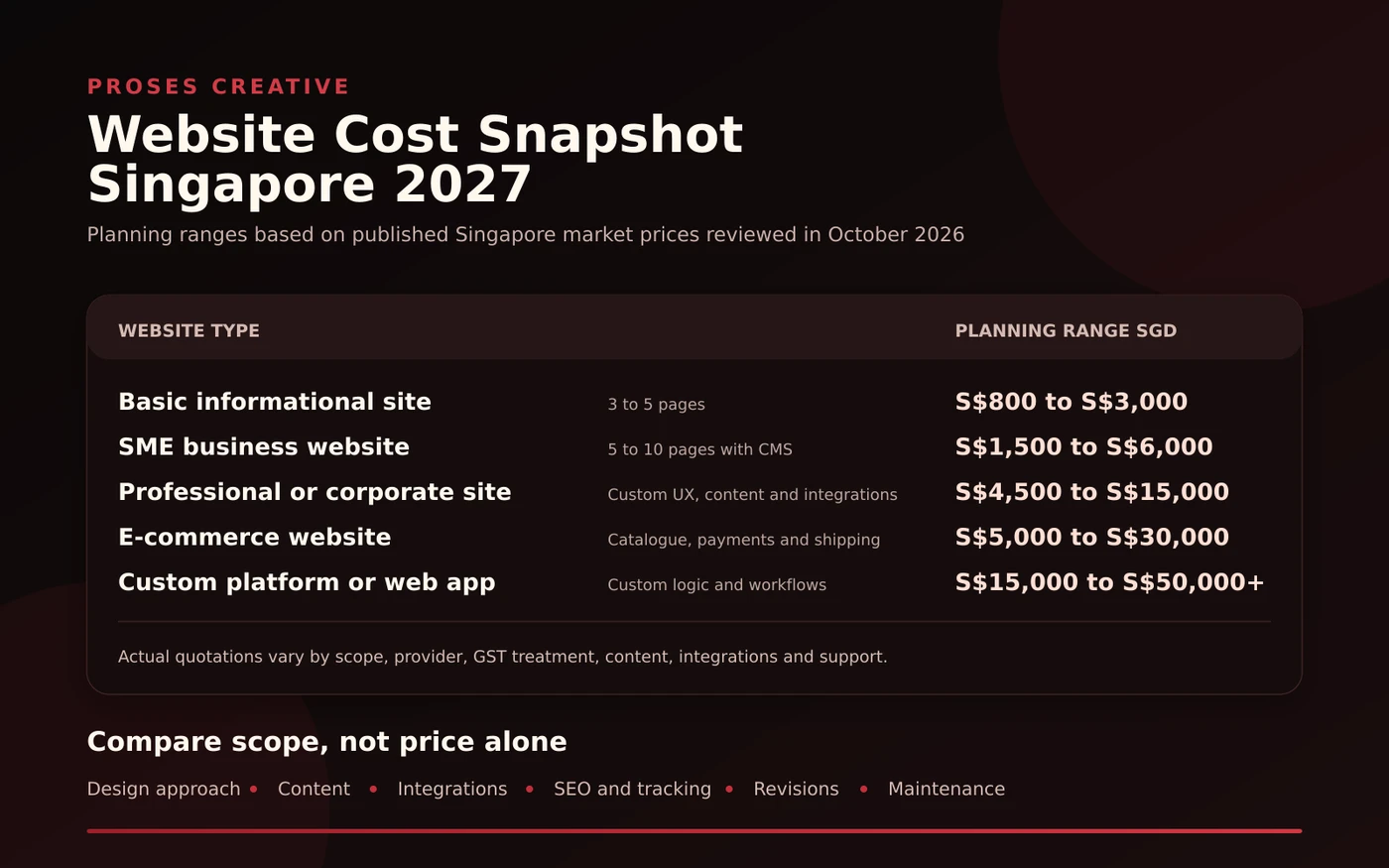
| Website type | Typical scope | Planning range in SGD | Typical timeline |
|---|---|---|---|
| Basic informational website | Three to five pages, template-based design, contact form and mobile responsiveness | S$800 to S$3,000 | Two to four weeks |
| SME business website | Five to ten pages, content management system, customised design and basic SEO setup | S$1,500 to S$6,000 | Four to eight weeks |
| Professional or corporate website | Strategy, custom UX and UI, professional content, analytics, SEO foundations and integrations | S$4,500 to S$15,000 | Eight to sixteen weeks |
| E-commerce website | Product catalogue, cart, payment gateway, shipping rules, inventory and transactional testing | S$5,000 to S$30,000 | Ten to twenty weeks |
| Custom platform or web application | Custom workflows, user accounts, dashboards, databases and third-party systems | S$15,000 to S$50,000 or more | Three to nine months or more |
These ranges overlap because page count alone does not define complexity. A polished six-page corporate website with original copy, custom animations and CRM integration may cost more than a twenty-page site built with one reusable template.
Why do web design quotations vary so much?
Two providers can quote very different prices for what appears to be the same website. The difference usually comes from scope that has not been made visible in the proposal.
Business strategy and discovery
A lower-cost project may begin with a form asking for your logo, colours and page list. A strategy-led project usually includes stakeholder interviews, audience research, competitor review, customer journey planning, conversion goals and a measurement plan. Discovery work increases the initial cost, yet it reduces expensive changes later in the project.
Template design or custom UX and UI
Template-based websites use an existing layout that is adapted to your brand. This approach can be efficient for a straightforward company profile or campaign microsite. Custom design starts with your content, audience and conversion path, then develops original wireframes and interfaces around them.
Neither approach is automatically better. A well-chosen template can be the right commercial decision for a young business. A custom interface becomes more valuable when the website plays a major role in lead generation, e-commerce, customer service or brand positioning.
Pages and unique layouts
Providers often estimate effort by unique page templates rather than total page count. Ten service pages that use one shared layout require less design work than six pages that each need a different structure, interaction and visual treatment.
A useful quotation should identify both the number of pages and the number of unique layouts. This distinction prevents a disagreement when one party expects every page to be individually designed.
Copywriting, photography and content entry
Website content is frequently excluded from entry-level packages. The client may be expected to provide final copy, correctly sized images, staff profiles, product details, legal pages and translations before development begins.
Professional copywriting, content strategy, photography, video production, image licensing and product entry add cost because each requires specialist time. Content delays can also extend the launch date even when the design and code are ready.
Functionality and integrations
Contact forms are relatively simple. Booking systems, member areas, payment gateways, product filters, multilingual content, CRM connections, inventory synchronisation and customer dashboards require additional planning, development and testing.
Every integration should be listed by name in the proposal. The quotation should also state whether subscription fees, API usage, premium plugins and future updates are included or billed separately.
SEO, analytics and conversion tracking
Basic SEO is not the same as installing an SEO plugin. A search-ready build may include keyword-led information architecture, crawlable navigation, page titles, meta descriptions, canonical tags, structured data, image optimisation, redirects, XML sitemaps and internal linking.
Measurement setup may include Google Analytics 4, Google Tag Manager, Search Console and conversion events for lead forms, phone calls or purchases. These items matter because a website cannot improve business performance when important actions are not measured.
Testing, accessibility and performance
Quality assurance can cover browsers, mobile devices, screen sizes, form validation, payment flows, broken links, page speed, keyboard navigation and accessibility. A cheap quotation may include only a visual check on one desktop and one phone.
Clear acceptance criteria protect both parties. The proposal should define the browsers, devices, performance targets and accessibility level included in the project.
Revision rounds and stakeholder management
More decision-makers usually mean more meetings, feedback cycles and approval time. A fixed-price quotation commonly limits the number of revision rounds to control this workload.
The contract should explain what counts as a revision, what happens after the included rounds and how a change in scope is priced. A new feature requested after design approval is normally a scope change rather than a minor revision.
What should you receive at each price level?
| Budget level | What is commonly included | What to check carefully |
|---|---|---|
| Below S$1,500 | One-page or small template site, client-supplied content, basic form and mobile layout | Ownership, support, hosting, licences, SEO setup and revision limits |
| S$1,500 to S$6,000 | Professional SME website, CMS, several pages, light customisation, basic analytics and SEO foundations | Copywriting depth, custom layouts, tracking events, maintenance and migration |
| S$6,000 to S$15,000 | Strategy, custom UX and UI, stronger content support, integrations, technical SEO, tracking and structured QA | Integration limits, accessibility targets, content ownership and post-launch warranty |
| Above S$15,000 | Complex e-commerce, custom platforms, advanced integrations, research, workshops and extended delivery teams | Milestones, system documentation, security, service levels and long-term operating costs |
Freelancer, agency or DIY website builder
The right provider depends on your budget, internal capacity and the role of the website in your business.
| Option | Best suited to | Main advantage | Main risk |
|---|---|---|---|
| DIY website builder | Very small sites with simple requirements and an owner willing to build and maintain them | Lowest upfront cash cost | Your time, design limitations and recurring platform fees |
| Freelancer | Defined projects with one main skill set and a responsive internal project owner | Lower overhead and direct communication | Limited capacity, availability and specialist coverage |
| Boutique agency | SMEs that need strategy, design, development and marketing to work together | Broader skills with close collaboration | Higher cost than a solo provider |
| Full-service agency | Corporate, regional, e-commerce and integrated projects with several stakeholders | Specialist team, structured process and delivery capacity | Larger investment and more formal processes |
A lower hourly rate does not always create a lower total project cost. Weak planning, unclear ownership or missing documentation can generate rework, delays and a second rebuild.
Website costs that are often missing from the first quotation
The build price is only one part of the total cost of ownership. A fair comparison includes the expenses that continue after launch.
- Domain registration commonly renews every year and varies by extension.
- Website hosting depends on traffic, storage, security, backups and support.
- Maintenance may include CMS updates, plugin updates, malware monitoring, backups and minor content changes.
- Premium themes, plugins and apps may renew monthly or annually.
- Business email is often licensed separately from the website.
- Payment gateway fees can include setup, transaction and platform charges.
- Content updates require internal staff time or an external retainer.
- SEO and digital marketing are ongoing growth activities rather than one-time development tasks.
- Analytics and consent tools may require paid plans as traffic and compliance needs grow.
A proposal should show the first-year cost and the expected annual cost from year two. It should also state which accounts belong to your company, especially the domain, hosting, analytics, advertising platforms and website administrator account.
How long does it take to design and build a website?
A simple microsite can launch in two to four weeks when the content is ready. A typical SME website often needs four to eight weeks. Strategy-led corporate websites may require eight to sixteen weeks, while e-commerce stores and custom platforms can take several months.
The client affects the timeline as much as the development team. Slow content delivery, unclear feedback, new requirements and delayed approvals are common reasons projects miss their launch date.
A reliable schedule should show discovery, sitemap, content, wireframes, visual design, development, content entry, testing, training and launch. Approval deadlines should appear beside each stage.
How to compare web design quotations fairly
Price comparisons become useful only when every provider receives the same written brief. Ask each provider to itemise the following points.
- Project goals and the primary action visitors should take
- Target audiences, markets and languages
- Number of pages and unique page templates
- Template-based, customised or fully custom design
- Copywriting, photography, video and content entry responsibilities
- CMS or e-commerce platform
- Forms, booking tools, payment methods and integrations
- On-page SEO and technical SEO deliverables
- Analytics, tag management and conversion events
- Migration, URL redirects and search ranking protection
- Mobile, browser, accessibility and performance testing
- Number of design concepts and revision rounds
- Training, documentation and administrator access
- Warranty, maintenance and response times after launch
- Third-party subscriptions and annual renewal costs
- GST treatment, payment milestones and change-request rates
A proposal that clearly defines exclusions can be more trustworthy than a cheaper package that promises everything without explaining the scope.
Three example website budgets for Singapore businesses
Lead generation website for a service company
An eight-page website may include a homepage, about page, four service pages, case studies and contact page. A sensible scope could add light discovery, customised design, copy editing, a CMS, enquiry form, basic technical SEO, GA4, Search Console and lead-form tracking.
A practical planning range is approximately S$4,000 to S$9,000, depending on the amount of original design and copywriting. Professional photography, multilingual pages, advanced calculators or CRM automation would increase the budget.
E-commerce store with fifty products
A retail project may need product templates, category pages, search, filters, cart, checkout, payment methods, shipping rules, transactional emails, analytics and staff training. Product photography and data entry can become major cost items.
A practical planning range is approximately S$8,000 to S$20,000 for a standard implementation. Custom inventory connections, loyalty programmes, subscriptions, marketplaces or regional storefronts can push the project above this range.
Customer portal with accounts and dashboards
A portal may require authentication, user roles, secure data, dashboards, document uploads, notifications and integrations with internal systems. This is closer to software development than a conventional marketing website.
Budgets commonly begin around S$20,000 and can rise significantly after technical discovery. A paid discovery phase is valuable because it converts broad ideas into user flows, functional requirements, architecture and delivery milestones.
Questions to answer before requesting a quotation
- What business result should the website produce?
- Who is the primary audience?
- Which pages and features are essential at launch?
- Which features can wait for a second phase?
- Who will write, review and approve the content?
- Which systems must connect to the website?
- Which conversions must be tracked?
- Who will update the website after launch?
- What is the target launch date?
- What budget range has been approved?
Clear answers help an agency recommend the right solution instead of adding a risk allowance to an uncertain brief.
Are website grants still available in Singapore?
Singapore’s EDG, MRA and PSG schemes ceased on 29 September 2026. New applications from 30 September 2026 use the EDGE Grant, subject to the eligible activity and current Enterprise Singapore requirements.
Grant eligibility should be checked before committing to a supplier or making a payment. A website project is not automatically eligible simply because it supports digitalisation.
Frequently asked questions about web design prices in Singapore
How much does a simple website cost in Singapore?
A simple three-to-five-page informational website commonly falls between S$800 and S$3,000. The lower end usually assumes a template, client-supplied content and limited revisions. Custom design, copywriting, SEO and tracking move the project towards the higher end.
Why can a S$999 website cost more later?
A low entry price may exclude hosting, maintenance, premium licences, content, SEO, analytics, additional pages and future changes. Ownership restrictions or a proprietary platform can also make migration expensive. The total cost over two or three years provides a better comparison than the launch price alone.
Does web design include SEO?
Some packages include basic on-page setup, while others include only the visual design and development. A search-ready scope should specify information architecture, metadata, crawlability, schema, redirects, performance, image optimisation, analytics and Search Console. Ongoing SEO content and authority building are normally separate services.
How much should an SME budget for website maintenance?
Maintenance can range from a small annual fee for a static site to several hundred dollars per month for an actively managed WordPress or e-commerce website. The scope should clarify updates, backups, security monitoring, uptime checks, support hours and content changes.
Should a business use WordPress, Shopify, a website builder or custom development?
WordPress suits many content-led business websites and offers broad provider choice. Shopify is often practical for standard e-commerce. Website builders can work for simple sites managed by the owner. Custom development becomes appropriate when the business needs unique workflows, data structures or integrations that standard platforms cannot support efficiently.
Do website quotations include GST?
GST treatment varies by provider. Some published prices include GST, some exclude it and some providers are not GST-registered. Every quotation should state the tax treatment clearly.
How can I get an accurate web design quotation?
Send every shortlisted provider the same brief, required pages, features, integrations, content responsibilities, timeline and budget range. Ask for itemised deliverables, exclusions, annual costs and ownership terms. Proses Creative can review your requirements and turn them into a practical scope through our project brief form.